
Georgetown Resident Lookup Coverage
Every official source proves a different slice of one person's identity. Pull the narrowest match first, then confirm it with a second custodian instead of treating a shared surname and city as proof.
| Record | What It Confirms | Where | Access |
|---|---|---|---|
| Parcel card | Listed owner and tax mailing clue | Scott County PVA | Free search advertised |
| Voter record | Current registration and polling purpose | Kentucky VIC | Required identity fields |
| Court case | Party, county, case type and events | CourtNet or Scott clerk | Online service and office |
| Vital index | Indexed birth, marriage, or death | OVS, FamilySearch, library | Index and restricted copies |
| Business filing | Officer or registered-agent affiliation | Kentucky SOS | Online search |
| License | Credential and status by board | Kentucky DPL | Online verification |
| Newspaper | A dated local appearance | Scott digital archive | OCR plus page image |
A property owner may not occupy the parcel. Voter rolls are not a census either. Even a listed business address can belong to an entity rather than the person, and noticing that difference is what keeps a resident lookup honest.
Define the Georgetown Resident First
Write out the full name and every variant you can imagine. Do this before typing anything into a search box. Add initials, a middle name, suffixes, and maiden or former names. Likely misspellings belong on the list too. Note the approximate date and any known street. Add a spouse or relative. Record whether the subject is current, historical, or deceased.
Then match on two independent keys. Birth date will serve, and so will county or parcel description. Party role, a relative, record date, cemetery lot, or an occupation from a dated source will all serve too. Reject any result where the facts clash. Common-name errors spread easily. Searchers copy a match before asking whether it is even the same person.
Note: Keep the exact URL, date checked, record number, accepted facts, and the reason each same-name result was rejected.
Match Georgetown Court Records Carefully
CourtNet 3 needs a jurisdiction before anything else. Party mode takes a last name of at least three characters plus a birth date. A last-plus-first name pair works as well. Driver number and limited SSN modes also exist. Exact, starts-with, and sounds-like options cover name variants.
A result can show party name and type, personal identifiers, county, case number and type, title. A next event can appear as well. Clicking the case can expose parties, charges, and scheduled dates. Blue and gold grouping are just similarity aids. They are not identity findings. A summary view may stop short of a final disposition.
| Party | The person's role in the case, not proof of conduct. |
|---|---|
| Case number | The key used to request the actual file. |
| Case type | The court category that narrows a same-name match. |
| Next event | A scheduled event, not a final outcome. |
| W, S, FTA | Portal indicators for warrant, summons, or failure to appear. |
For the file itself, contact the Scott County Circuit Court Clerk at 119 N Hamilton Street, 502-863-0474, weekdays 8:30 a.m. to 4:30 p.m. The clerk can explain copies, certification, storage, and where historical files live now. KDLA's judicial index is a partial fallback. The Kentucky historical judicial index source helps route older Scott County case research to an accession or order path. Check both party names when possible.
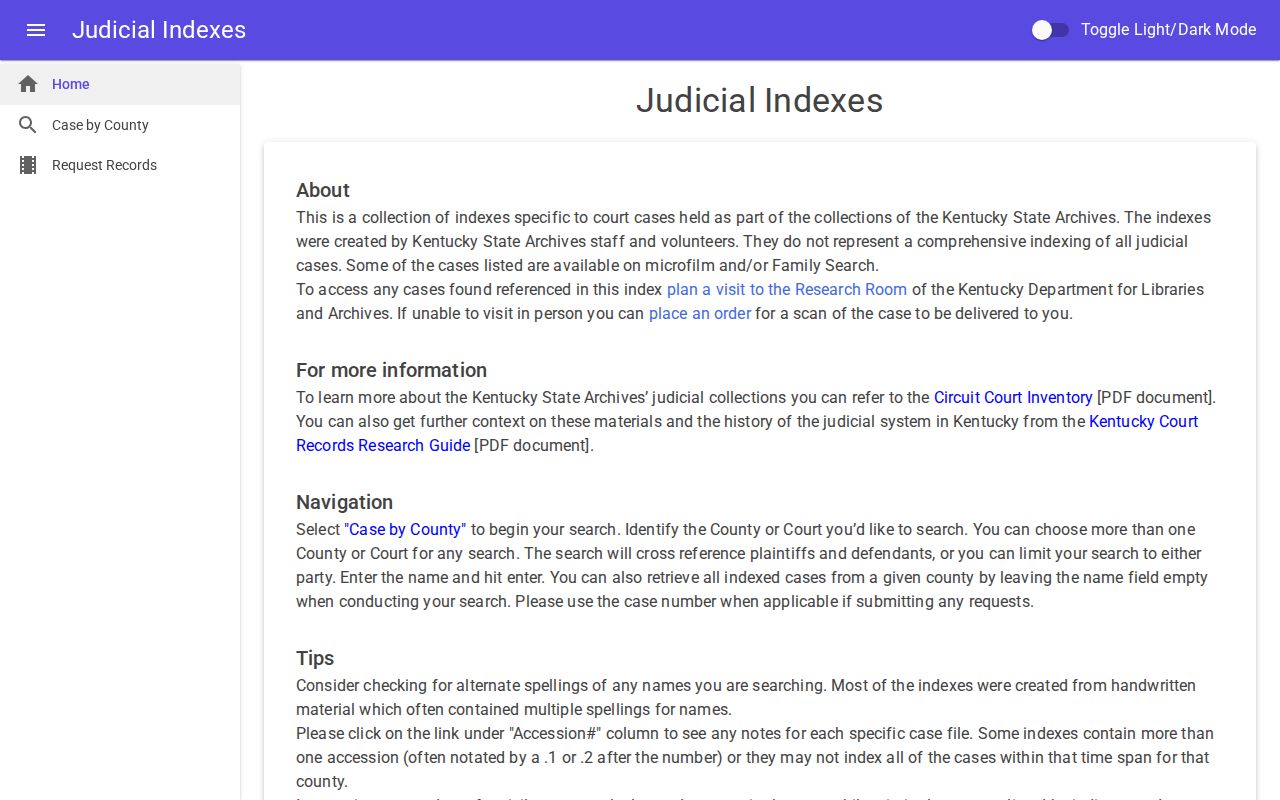
The image shows the historical index route in action. A query there should be checked against both parties and then followed with a request for the underlying record.
Confirm Georgetown Voter Registration
The Kentucky Voter Information Center needs legal first and last names, a birth date in MM-DD-YYYY form, and optionally the last four SSN digits. Its stated purpose is narrow. It confirms registration, polling place, and absentee-ballot status. Full addresses, party history, ballot choices, and all residents at one address stay off screen.
| Field | Format | Required | Use |
|---|---|---|---|
| Legal First Name | Text | Yes | Identity match |
| Last Name | Text | Yes | Identity match |
| Date of Birth | MM-DD-YYYY | Yes | Narrows same names |
| Last four SSN | Four digits | No | Optional match aid |
Broader voter files run under separate rules. KRS 116.095 and 31 KAR 3:010 govern them, with public portions listing name, address, age code, party, gender, ZIP, and voting history. SSNs are redacted. SBE-84 access carries eligibility, oath, purpose, scope, fee, and use controls, and the Scott County Clerk election branch answers inspection questions.
Verify Georgetown Resident Records
Build the match one clue at a time. For an address link, the PVA owner name is only a starting point. It is not proof of occupancy. Carry the official owner or entity name into the deed index and compare the legal description before concluding anything.
- Normalize the person's name and record the date or address already known.
- Check the relevant official roll, then save only fields the source displays.
- Search CourtNet with Scott jurisdiction and a qualifying name combination.
- Compare a vital index, dated newspaper, license, or business filing.
- Request the source image or certified copy from its custodian when needed.
- Docket
- The chronological list of filings and events in a court case.
- Index versus image
- An index points to a record; an image shows the scanned source.
- Certified copy
- An official reproduction authenticated by the record custodian.
Old households need different tools. The Georgetown city directories and archive page maps the historical shelf without stretching a modern resident lookup into a family-history survey.
Confirm Georgetown Vital Events
The Kentucky Office of Vital Statistics keeps certified birth, death, marriage, divorce, and stillbirth records. Marriage and divorce registration begins June 1958. Before that, Scott marriages sit with the county clerk. Older divorces go to the circuit clerk.
A birth copy costs $10. Death, stillbirth, marriage, and divorce copies cost $6 each. Mail and dropbox orders usually take about five business days, though OVS says allow up to 30 working days. Eligibility and ID depend on the record and its date, and KRS 213.131 opens births after 100 years and deaths after 50.
The Kentucky Vital Record Indexes, 1911-1999 can corroborate a name, event, place, or relative. An index hit is not a certified copy. It guarantees no image access either, so order through OVS forms, the counter, mail, dropbox, or the official phone and online vendor route.
Locate Georgetown Heirs and Classmates
Heir work starts with paper. Gather will books, probate files, court material, an obituary, and cemetery records. Then trace the deed that moved the parcel. Older Scott wills sit in the library archive. The court clerk and KDLA hold other files. For someone deceased, add the vital index and the Kentucky Treasury unclaimed-property route.
A former classmate may turn up in library newspapers. Family files, local histories, and oral history recordings help too. Georgetown publishes no yearbook directory of its own. Ask the library or the Georgetown College archive directly. Birth-parent questions follow a separate path. Kentucky's official adoption or confidential-intermediary process handles them. Never attempt to expose a protected address.
Check Georgetown Business Connections
The Kentucky Business Entity Search ties a name to an officer, founder, director, or registered-agent role, with entity status, formation date, office, agent, officers, and filing dates on view. A filing proves a business affiliation. It does not prove a Georgetown home.
The Department of Professional Licensing search runs in individual or business mode with filters for board, name, license number, status, and location. Some boards keep their own portals. Treat a credential as a second identity key. When a city permit or license is not posted online, file a narrow request naming the person, permit type, and date range.
Understand Scott Custody Results
The Scott County Detention Center inmate lookup page lists current custody. A roster is time-sensitive, so confirm any status with the facility before drawing a conclusion.

A roster is one lead only. The detention center sits at 130 N Court Street and answers at 502-863-7880.
Respect Georgetown Resident Lookup Limits
Safe at Home can substitute a protected address. Sealed, juvenile, mental-health, adoption, expunged, and protected court files may simply not appear. Vital records stay sealed until their opening rules apply. Driver data and voter rolls carry their own statutory limits. These boundaries are deliberate.
The Kentucky Consumer Data Protection Act took effect January 1, 2026. It grants rights over covered commercial personal data but excludes public-record information, so it never erases a deed or court record. Is an official record wrong? Ask its custodian about a correction. When an unposted government record is open, file a narrow Kentucky Open Records Act request under KRS 61.870 through 61.884.
Lawful use. Use a Georgetown resident lookup only for lawful personal research. Never use it to stalk, harass, intimidate, or expose a protected person.
Commercial compilations can be stale, duplicated, or attached to the wrong person. They cannot open a restricted record. They also cannot replace the clerk, court, OVS, elections office, SOS, licensing board, or library. The official trail sometimes ends at a protected record. When it does, stop.